

Pakistan announced on 3 November 2026 that it had successfully completed a flight test of the Fa’az, describing it as the country’s first indigenously developed air-to-air missile. The announcement has drawn attention because it points to another step in Pakistan’s effort to develop more of its own aerospace and defence equipment.
For readers trying to understand the news, two questions matter more than the headline: what does an air-to-air missile do, and what has actually been disclosed about Fa’az? The official statement confirms a successful flight test and a terminal guidance system, but it does not publish a numerical range or a full technical specification.
What the Fa’az announcement confirms
According to the statement issued by Inter-Services Public Relations (ISPR) and carried by Radio Pakistan, Fa’az is an air-to-air missile developed indigenously in Pakistan. The statement says it has a terminal guidance system and can engage aerial targets at longer ranges. It also says senior military officers, scientists and engineers involved in the development witnessed the launch.
Footage released with the announcement was described by Dawn as showing the missile being launched from a JF-17 fighter aircraft. The public statement itself does not provide a detailed list of the aircraft or variants with which the missile may eventually be integrated.
| Publicly confirmed | Not specified in the announcement |
|---|---|
| Successful flight test on 3 November 2026 | Exact operational range in kilometres |
| Described by ISPR as Pakistan’s first indigenously developed air-to-air missile | Specific seeker or guidance technology |
| Terminal guidance system | Speed, propulsion details or engagement envelope |
| Ability to engage aerial targets at longer ranges, according to ISPR | Production quantity, delivery schedule or operational induction date |
What is an air-to-air missile?
An air-to-air missile is launched from an aircraft to engage another airborne target. It is different from a surface-to-air missile, which is launched from a ground or naval platform, and from an air-to-ground weapon designed to attack targets on land or at sea.
Modern air-to-air missiles use guidance systems to steer towards a target. The term terminal guidance refers to the guidance function used in the final part of the flight, when the weapon is approaching the target. That description alone does not reveal whether Fa’az uses radar, infrared or another specific guidance arrangement. ISPR has not publicly named the seeker type.
The phrase “longer range” is also relative. Without an official figure and a defined test condition, it cannot be converted into a reliable distance or compared numerically with another missile. Range can depend on several factors, including launch conditions, target movement and the missile’s flight profile. None of those performance details was included in the announcement.
Why indigenous development matters
Developing a weapon domestically can give a country greater control over design decisions, maintenance planning and future upgrades. It may also help local engineers build experience in propulsion, electronics, guidance, testing and systems integration. Those are potential industrial benefits, not proof that every component of a newly announced system is made locally.
For the Pakistan Air Force, a domestically developed air-to-air weapon could eventually offer another option in the wider mix of aircraft, sensors, training and weapons used for air defence. Its practical value will depend on reliability, integration with aircraft and sensors, maintenance support, pilot training and the number of systems that enter service.
What a successful flight test does—and does not—prove
A successful test is an important development milestone. It indicates that the test programme achieved its stated objective under the conditions of that particular trial. It does not, by itself, establish that a missile has completed every stage of evaluation, entered operational service or been produced in large numbers.
To assess the longer-term significance of Fa’az, readers should look for further official information on the completion of testing, the aircraft platforms involved, production and induction, and any published performance data. Until such details are released, claims about a precise range, combat record or superiority over a named foreign system should be treated cautiously.
What to watch for in future updates
- Testing milestones: Whether the authorities announce further trials or completion of the development programme.
- Platform integration: Which aircraft are officially confirmed as compatible, rather than inferred from a launch video.
- Operational status: Whether the missile is formally inducted into service and in what numbers.
- Technical disclosure: Whether the government publishes verified performance information, including a defined range or guidance description.
- Industrial contribution: Whether further details clarify the local design, manufacturing and supply-chain role.
The Fa’az test is a noteworthy announcement about Pakistan’s aerospace development. The most accurate assessment is also the simplest: a successful flight test has been announced, a terminal guidance system has been confirmed, and several important performance and deployment details remain undisclosed.
Official announcement: Radio Pakistan’s report on the Fa’az flight test.
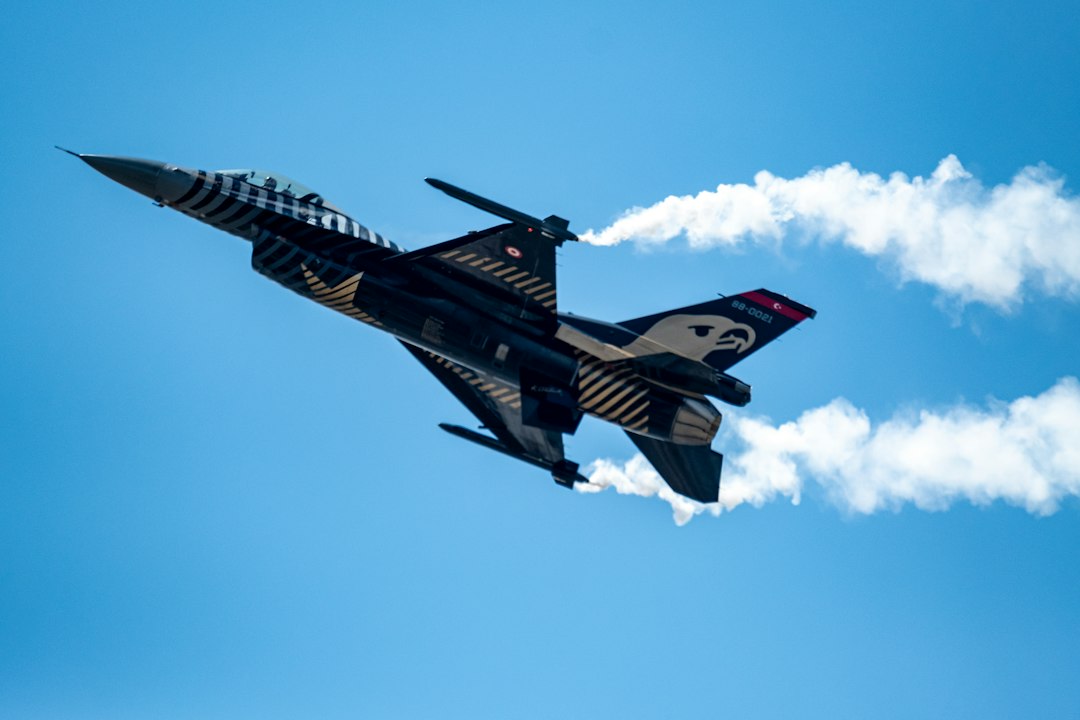
Featured image: Illustrative fighter aircraft photograph by Hamza Şamil Yavuz/Unsplash. The aircraft shown is not the Fa’az test aircraft and the image does not depict the missile.